

 On occasion of the World Engineering Day, we interviewed the CIMNE researcher Jaime Martí Herrero. Member of CIMNE Beegroup since 2008, he is a doctor in Physical Sciences. In 2009, he began to develop research, development and implementation projects in Bolivia related to biodigesters. This activity led him to visit and collaborate in biodigesters with most Latin American countries. In 2014, he moved to Ecuador, where he is currently a tenured professor at the Ikiam Amazon Regional University. His profile combines applied research activities and international cooperation activities, implementing projects mainly in rural communities. His research work is reflected in about thirty indexed scientific articles, some of them published on open access.
What are the main challenges in the short, medium and long term of CIMNE projects in Latin American communities?
In this type of projects, to be successful, the engineering part is 20% and the social one is 80%
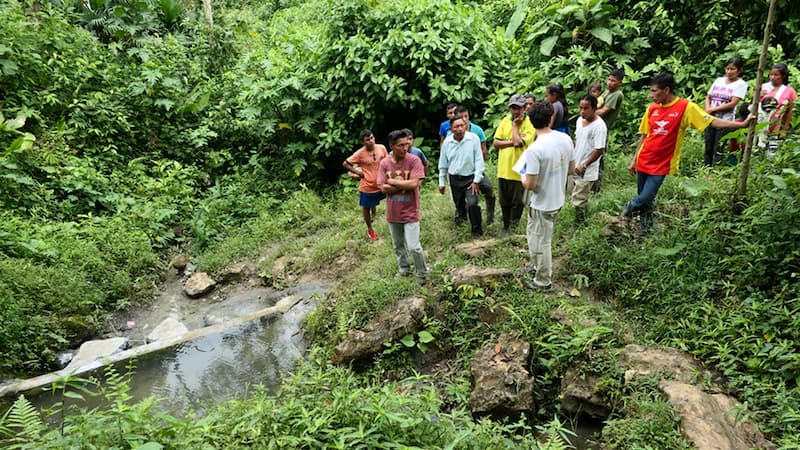
In the projects that CIMNE develops, together with other actors, in rural communities in Latin America, trying to solve basic infrastructure problems such as water, waste treatment, energy and agriculture. From CIMNE, the projects are currently focusing on supplying drinking water and treating wastewater through biodigesters to Amazonian Kichwa indigenous communities.

The challenge is always for projects to be sustainable, meaning that, once the implementation of a water collection, purification and distribution system has been completed, the system continues to function autonomously over time. Thus, it is very important for the community, the group of people who are beneficiaries of the projects, to involve them in the entire process (from design to implementation), so that they take ownership of the system and can give it a long-term operation and maintenance. In this type of projects, to be successful, the engineering part is 20% and the social one is 80%. In Latin America, the key is, on the one hand, knowing the local context in which you are going to work and, on the other, relying on other actors (NGOs such as Green Empowerment or ENGIM; Universities such as Ikiam; or city halls such as Archidona).
From CIMNE, the projects are currently focusing on supplying drinking water and treating wastewater through biodigesters to Amazonian Kichwa indigenous communities
What should be the role of engineering in the development sustainable?
The role of engineering in sustainable development must be as a tool, as a catalyst for processes that help improve the living conditions of the most disadvantaged population and help reduce the excess consumption of resources by the most wealthy population.

Engineering applied to sustainable development must be very aware of the environmental crisis we are experiencing, of the biophysical limits of the planet (of the 9 established we have already exceeded 5), and of the limited energy and mineral resources that we have. Engineering is not neutral and it must consider its environmental and socio-economic impacts. Engineering is a double-edged sword that can allow us achieving a just and resilient society in the face of the environmental crisis, or it can increase social injustices and environmental degradation. The key is to focus on engineering appropriate to the current context in which we live that encourages the reduction of inequalities.
Engineering is not neutral and it must consider its environmental and socio-economic impacts
Do you think that engineering can be an agent of social cohesion?
Yes it can be, but it can also be the opposite. This is a fundamental aspect and one that, unfortunately, often escapes the world of engineers, who sometimes take distance from the socio-environmental implications of the proposals they make. Engineering is based on helping to solve human problems, and that is where users must be prioritized, without forgetting those who may be affected. For example, participatory processes of society in the development of engineering solutions are always a factor that helps social cohesion, as well as more decentralized engineering proposals that involve society in their use, maintenance, and operation. In Latin America, a term that is “empowering” is widely used, and technology can help empower societies to make them more sovereign and resilient. But beware, engineering can also do the opposite.